HUD recently announced the availability of up to $362,000 for one or more grants from FY 2019 funding from the Office of Policy Development and Research for a research project examining long-term outcomes for individuals following their exit from HUD-assisted housing. HUD's research objective for this project states:
"This solicitation seeks to examine long-term outcomes of households who have exited HUD assisted housing (all programs), also referred to as "leavers." HUD’s purpose is to learn how housing assistance can better support good outcomes, such as economic opportunity and self sufficiency of assisted households, enabling households to exit HUD assistance and thus increase the availability of scarce housing resources for other families in need. HUD is soliciting proposals to explore this topic by taking advantage of HUD administrative or tenant data linked with other longitudinal data sources on households or individuals. The results of such data linkages may also inform and contribute to HUD’s continuing efforts to understand trends in “positive” and “negative” exits from its programs."
Applications are due July 14, 2020.
Last week, HUD’s Office of Asset Management and Portfolio Oversight (OAMPO) released a memo indicating that HUD will be allocating CARES Act supplemental funding resources for PBRA properties. When CLPHA members learned that HUD was not releasing the funds, they reached out to HUD officials to explain how releasing the funds would provide increased support for programs pivotal in preventing the effects and spread of coronavirus in member communities. As a result of our members’ efforts additional relief will be reaching an estimated 16,500 Section 8 properties.
According to the memo, HUD will soon disperse $800 million in approved Project-Based Rental Assistance (PBRA), out of the initially approved $1 billion. No other action is needed by PBRA owners to receive the funds. The remaining $200 million will be dispersed using an allocation methodology to be outlined in a subsequent notice.
While we hope our members will take pride in their efforts to the release of this most recent funding package, we understand the work that lays ahead. This pandemic and economic crisis is not ending anytime soon, and there are no communities more affected than our own.
For questions about CARES Act funding for PBRA, please contact Research and Policy Analyst Joshua Shokoor at [email protected].
To:
Members of the U.S. Senate Committee on Banking, Housing, and Urban Affairs
Members of the U.S. House of Representatives Committee on Financial Services
Members of the U.S. Senate Committee on Appropriations
Members of the U.S. House of Representatives Committee on Appropriations
From:
Sunia Zaterman, Executive Director, Council of Large Public Housing Authorities
Gerard Holder, Legislative Director, Council of Large Public Housing Authorities
RE: The Time is Now for Housing Choice Voucher Expansion
Critical Moment
We must stand up and take action in the face of our triple national catastrophe of the COVID-19 pandemic, the ensuing economic calamity, and most importantly, our long history of systemic racial and economic inequalities. Now, more than ever, we should ensure secure, stable and safe housing for low income households and for those who are threatened by homelessness because they cannot pay rent or find a place to live. The pandemic has exacerbated the crisis in housing availability and affordability to levels never seen before. The Census Bureau's most recent survey highlights the staggering impact of COVID-19 with nearly 25 percent of all adults reporting housing insecurity, which is defined as either missing their rent or mortgage payment last month and/or expressing little or no confidence in their ability to afford their next housing payment.
In less than three months since the novel coronavirus reached the United States, the economic conditions have deteriorated rapidly. It is disproportionately affecting the same low-income families who are the most likely to already be struggling with housing affordability. This is causing significantly higher unemployment rates, and the depths of its effects on job security and health status among America’s most vulnerable families is very uncertain.
Congress's response through the CARES Act was swift and significant by appropriating $17 billion to U.S. Department of Housing and Urban Development programs, with $1.25 billion of those funds appropriated for “Tenant-Based Rental Assistance” that provides additional funds for public housing agencies for Housing Choice Vouchers.
However, the need is so great, it remains unmet. The recently introduced HEROES Act provides substantial housing-related resources. As the HEROES Act moves through the legislative process, CLPHA is calling for a significant additional expansion of the Housing Choice Voucher program as one of the most effective federal housing assistance delivery systems during the pandemic, and beyond.
Housing Voucher Program Expansion
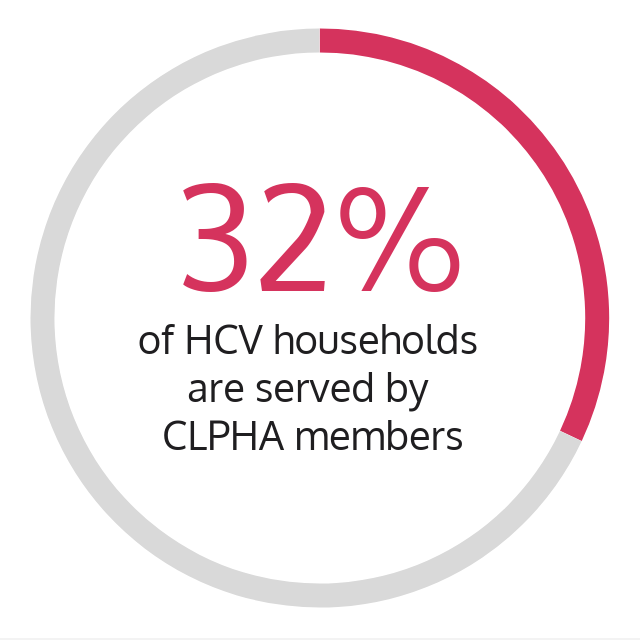
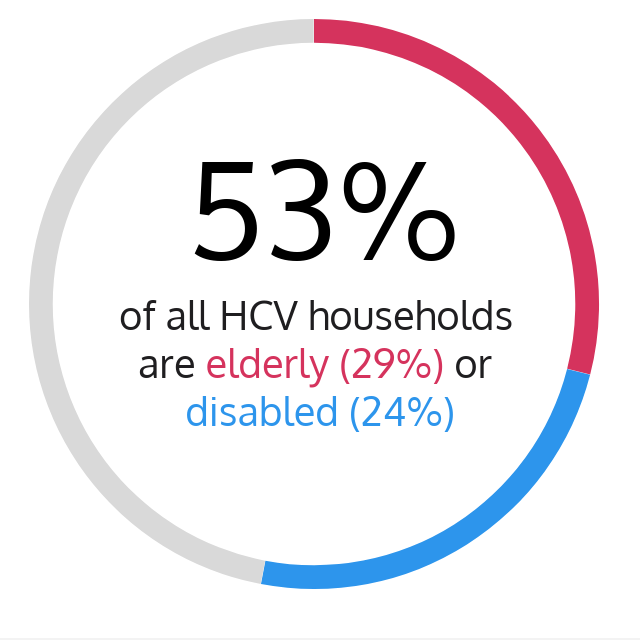
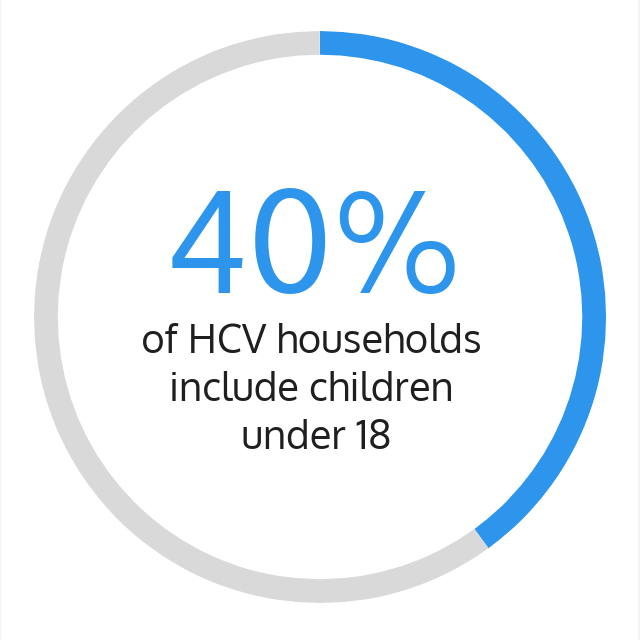
The Housing Choice Voucher (HCV) program currently serves 2.2 million households nationally. It is a critical component of the social safety net for low-income families. Paying the difference between a household’s total rent and 30 percent of their total income, the HCV program provides long-term housing stability, a measure of stability essential for promoting family stability and opportunities for economic self-sufficiency and mobility.
As a non-entitlement program, the HCV program currently serves approximately 1 out of every 4 households eligible to receive a voucher. According to analysis from the Terner Center for Housing Innovation, 16.5 million renter households have at least one worker employed in an industry that is likely to be affected by efforts to control the COVID-19 pandemic. An estimated 7 million of those households were already struggling with high housing costs prior to the beginning of the pandemic. With the Congressional Budget Office forecasting national unemployment to reach 16 percent by the third quarter of 2020, these households face significant and long-term challenges to job security, making it impossible for many to pay market-rate rent rental costs. The number of unassisted households eligible for the HCV program will increase, and these households will need long-term assistance to remain stably housed amid long-term impacts to many of the industries in which they are employed.
To respond to the needs of low-income renter households experiencing high rent burdens and employment loss, the best solution is to expand the HCV program to support them with long-term rental assistance.
Why Housing Choice Voucher Expansion is the Most Effective Policy?
-
Public Housing Authorities (PHAs) have the capacity for expansion. Nationally, over 2,000 PHAs administer vouchers. These agencies have the infrastructure in place that is needed to support a substantial increase in voucher availability. Using statutory and regulatory flexibilities granted by the CARES Act, PHAs are working to expedite the timeline between issuing a voucher and the household moving into a unit.
-
Vouchers are much more cost effective than other shorter-term rental assistance. A 2016 randomized study commissioned by HUD to examine various housing interventions for families involved with the child welfare system found that average monthly per-family program costs were $1,172 for vouchers compared to $4,819 for emergency shelter and $2,706 for transitional housing. Long-term assistance is the most cost-effective approach for ensuring long-term stability and avoiding episodes of homelessness or housing insecurity.
-
The unique effects of the COVID-19 pandemic require a unique solution. During the Great Recession, the Homeless Prevention and Rapid-Rehousing Program (HPRP) provided short-term rental assistance and was largely successful in preventing homelessness and reducing periods of homelessness. The COVID-19 pandemic is a disaster on an entirely different scale; a deeper, more long-lasting subsidy is needed to help families financially recover from the pandemic while remaining stably housed.
-
Rental providers may be more attracted to the voucher program as a stable income source, leading to more families being able to make use of their voucher. Especially in high-cost areas, PHAs have historically experienced challenges in recruiting landlords to participate in the voucher program. With many households having difficulty paying rent on time, landlords may view the voucher program more favorably as a guaranteed income source. PHAs can also use their CARES Act waiver authority to expedite administrative processes most often cited by landlords as reasons for preferring unassisted tenants.
-
PHAs have extensive experience with service provision and coordination. In addition to providing them with safe, affordable housing, PHAs are also in a position to provide or coordinate services that households are likely to need during recovery from the pandemic. Employment services through programs such as the Family Self-Sufficiency Program and Jobs Plus can help families who have experienced employment loss. PHAs also coordinate with schools, food programs, and health care providers to support families in a holistic way that unassisted households may have more difficulty accessing.
-
The voucher program can be expanded in several ways. Congress could appropriate an additional set of vouchers that are permanently awarded to PHAs, or PHAs could receive a set of vouchers that sunset after a certain time period. For example, vouchers could sunset after use by one or more households or after a specified number of years. Any of these methods would allow for families to receive longer-term rent assistance and could be modeled closely on current voucher program administration processes and rules.
The Time is Now for Housing Choice Voucher Expansion
The short- and long-term effects of the COVID-19 pandemic require a response proportional to the growing magnitude of this crisis. Through an expansion of the HCV program that PHAs have the capacity to manage, vouchers can provide cost effective assistance, bring landlords into the program, and provide cross-sector services to address the needs of low-income families through several possible expansion scenarios. An expansion of the voucher program is the best solution to address the growing affordability crisis among households affected by the pandemic.